
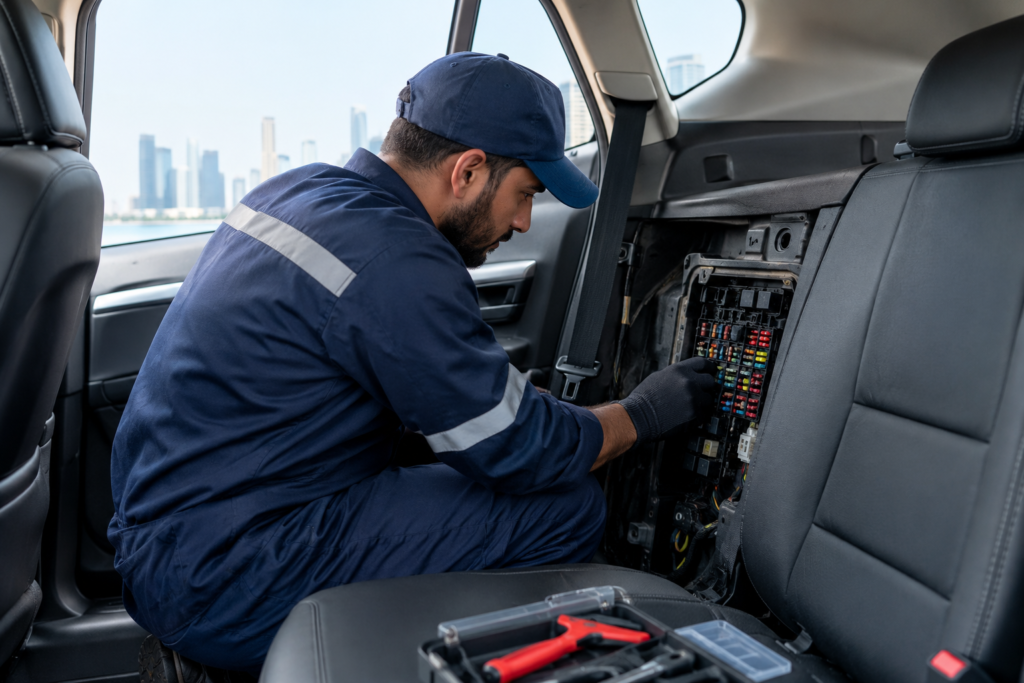
You turn the key on a 45 degree afternoon in Abu Dhabi and nothing happens. Or the dashboard lights up like a Christmas tree on Sheikh Zayed Road. Or your headlights dim every time the air conditioning kicks in on the Sharjah Corniche. These are all signs of an electrical problem, and in the UAE’s climate they tend to show up with very little warning.
A car electrical problem is any fault in the system that stores, produces or delivers power, including the battery, alternator, starter motor, fuses, wiring and sensors. Because modern cars rely on electronics for almost everything, from starting the engine to running the air conditioning, one small fault can cause several symptoms at once.
In this guide, we explain the most common car electrical problems across the UAE, the warning signs that help you identify each one, simple checks you can do yourself and the moment it is time to call a mechanic. Whether you drive in Dubai, Abu Dhabi, Sharjah, Ajman, Umm Al Quwain, Ras Al Khaimah or Fujairah, you will finish with a clear idea of what your car is trying to tell you.
Quick answer: The most common car electrical problems in the UAE are a weak battery, a failing alternator, a worn starter motor, corroded terminals, blown fuses and faulty wiring. Typical warning signs include slow starting, dim or flickering lights, a battery light on the dashboard and a car that dies unexpectedly.
What Is a Car Electrical System?
Your car’s electrical system is a network that makes, stores and distributes electricity. Think of it as the nervous system of the vehicle. Here are the main parts:
- Battery: stores the power needed to start the engine and run electronics when the engine is off.
- Alternator: recharges the battery and powers the car while the engine is running.
- Starter motor: turns the engine over when you press the button or turn the key.
- Fuses and relays: protect circuits and switch heavy loads like headlights and the cooling fan.
- Wiring and connectors: carry power and signals around the car.
- Sensors and the ECU: the engine computer reads dozens of sensors and manages fuel, ignition and emissions.
When one part weakens, the others work harder to compensate. That is why a tired battery often damages an alternator over time, and why catching problems early saves money.
Why the UAE Is Tough on Car Electrics
Heat is the biggest factor. AAA reports that in hot climates a car battery typically lasts around three years, compared with five years or more in cooler regions. Heat speeds up the chemical reaction inside the battery and the rate at which it wears out.
Local data tells the same story. In more than 20,000 inspections carried out by dubizzle Cars across the UAE in the first half of 2026, most vehicles showed battery health between 40% and 60%, and around 14% scored below 30%. Authorities including Dubai’s RTA advise motorists to check batteries and lights as part of regular summer maintenance, in line with the Ministry of Interior’s Accident Free Summer campaign.
Conditions differ a little from emirate to emirate, but the strain is similar everywhere:
- Constant air conditioning: the AC compressor and blower put a heavy load on the battery and alternator.
- Stop and go traffic: slow crawls on Sheikh Zayed Road, Emirates Road and the Sharjah to Dubai commute mean low engine speeds and less charging.
- Short trips: quick runs to the mall or the supermarket do not give the battery time to recharge.
- Long parking: cars left at Dubai, Abu Dhabi or Sharjah airports or at home during summer holidays slowly drain their batteries.
- Coastal humidity: the Corniche areas of Sharjah and Ajman, Dubai Marina, Al Marjan Island in Ras Al Khaimah and the east coast around Fujairah see more terminal corrosion.
- Inland heat and dust: Al Ain, Liwa and desert edge areas bring extreme temperatures, and fine sand gets into connectors.
9 Common Car Electrical Problems and How to Spot Them
1. A Weak or Dead Battery
This is the number one cause of breakdowns in the UAE. Signs include:
- Slow or sluggish cranking when you start the car
- A clicking sound but no start
- Dim headlights and interior lights
- The battery warning light on the dashboard
- A battery more than three years old
A battery usually fails gradually, so slow starts are the early warning you should not ignore.
2. A Failing Alternator
The alternator charges the battery while you drive. When it weakens, the car starts running on stored power until the battery drains. Look for:
- The battery or charging light staying on while driving
- Headlights that dim at idle and brighten when you rev
- A whining or grinding noise from the engine bay
- The car starting fine but stalling after a few minutes
- A burning smell from the belt or alternator
3. A Worn Starter Motor
If the battery is healthy but the engine will not turn over, the starter may be the issue. Symptoms are a single loud click, a grinding noise when you press start, or the engine turning over only some of the time. Heat and age wear down starter components, particularly in cars that stop and start often.
4. Blown Fuses
A fuse is a small safety device that breaks a circuit to prevent damage. If your power windows, radio, central locking, wipers or sockets suddenly stop working, a blown fuse is a likely cause. A fuse that keeps blowing means there is a deeper fault, such as a short circuit, and replacing it with a higher rated fuse is dangerous.
5. Corroded or Loose Battery Terminals
Look for a white, green or blue powdery crust around the battery posts. This corrosion blocks the flow of electricity and can mimic a dead battery. In humid coastal areas, it develops faster. Loose clamps can cause intermittent starting problems and flickering lights.
6. Faulty Wiring and Short Circuits
Years of heat can harden wire insulation until it cracks. Signs include a burning smell, melted plastic, flickering lights that come and go, repeated fuse failures and accessories that work intermittently. Poorly fitted aftermarket parts, such as audio systems and extra lighting, are also common causes. Wiring faults can lead to fires, so treat any burning smell as urgent.
7. Parasitic Battery Drain
This happens when something keeps drawing power after the car is off. A faulty relay, a boot light that stays on, a dashcam wired incorrectly or a failing module can all drain a healthy battery overnight. If your car keeps going flat after sitting for a day or two, parasitic drain is a strong suspect.
8. Faulty Sensors and Warning Lights
A check engine light, ABS light or airbag light can point to a failing sensor or a wiring issue. Do not ignore these lights. Sometimes a car runs normally, but a faulty sensor can still affect fuel use, performance and emissions. A diagnostic scan reads the stored fault codes and shows where to look.
9. Air Conditioning and Comfort Electrical Faults
In the UAE, a failing AC is not just uncomfortable, it is urgent. Blown AC fuses, a faulty compressor clutch or relay, and a weak blower motor are all electrical faults. If the AC cuts in and out, or the cooling fan does not run, have it checked before it leads to overheating.
Symptom Checker: What Is Your Car Telling You?
- Clicking sound, no start: weak battery, loose terminals or a starter issue
- Engine cranks slowly: weak battery or poor connection
- Starts then dies: failing alternator or fuel issue
- Lights dim at idle: alternator or battery
- Burning smell: wiring fault or overheated component
- Windows or locks stop working: blown fuse or relay
- Battery goes flat overnight: parasitic drain
- Random warning lights: sensor, wiring or module fault
Simple Checks You Can Do Before Calling a Mechanic
- Look at the battery. Check for corrosion, loose clamps, swelling or leaks.
- Check the dashboard. Note which warning lights appear and when.
- Test the lights. Turn on the headlights with the engine off and see if they are bright or dim.
- Check the fuse box. Your owner’s manual shows which fuse powers each system.
- Measure the voltage. With a multimeter and the engine off, a healthy battery reads about 12.6 volts. With the engine running, expect roughly 13.7 to 14.7 volts. A reading close to 12 volts with the engine off suggests a very low charge.
- Note the pattern. Does it happen when it is hot, after a long park or only when the AC is on? That detail helps a mechanic diagnose faster.
Do not touch airbag wiring or try to bypass fuses. Always remove jewellery and be careful around the battery.
Mistakes That Make Electrical Problems Worse
- Ignoring slow starting because the car still works
- Jump starting repeatedly instead of finding out why the battery dies
- Replacing a blown fuse with a higher rated one
- Fitting cheap aftermarket accessories without proper wiring
- Washing the engine bay with a strong jet of water
- Buying the cheapest battery rather than the right type for your car
When to Call a Mobile Mechanic in the UAE
Call a professional if:
- The car will not start and you are not sure why
- A warning light stays on
- You smell burning or see smoke
- Fuses keep blowing
- The battery keeps going flat
- You are stranded in the heat or on a busy road
A mobile mechanic can test your battery, charging system and starter at your home, office or roadside, whether you are in Dubai, Abu Dhabi, Sharjah or any other emirate. That saves you a tow and the hassle of waiting at a workshop. For deeper problems, such as wiring repairs or module faults, a workshop visit may be needed, and you will be told clearly which one applies.
For a closer look at your options, read our guides on mobile mechanics versus traditional garages in the UAE and what car repairs cost in the UAE.
How to Prevent Electrical Problems in the UAE Heat
- Test your battery every year once it is two years old, and before summer.
- Park in shade or covered parking whenever you can, including malls like Yas Mall, Dubai Mall and Sahara Centre.
- Clean the terminals to stop corrosion building up.
- Drive regularly. If you are travelling, ask someone to start the car weekly or use a maintenance charger.
- Switch off lights and accessories before leaving the car.
- Have accessories fitted professionally to avoid wiring faults.
- Act on the first warning sign. A slow start today is a breakdown next week.
Why UAE Drivers Trust Autofix DXB
Auto fix DXB is a Dubai based car repair business serving all seven emirates, with workshop service and mobile repair, 14 years of combined technician experience and more than 2,000 jobs completed. We diagnose electrical faults properly, explain what we find in plain language and fix the cause rather than just the symptom. You can find out more on the Autofix DXB homepage.
Frequently Asked Questions
What are the most common car electrical problems in the UAE?
The most common problems are a weak battery, a failing alternator, a worn starter motor, corroded terminals and blown fuses. The UAE’s heat speeds up wear on all of them, so slow starts, dim lights and warning lights on the dashboard are signs worth checking early.
How do I know if my car battery or alternator is the problem?
If the car will not start but runs after a jump start, the battery is the more likely cause. If it starts but dies while driving, or the battery light comes on, suspect the alternator. A mechanic can confirm with a quick voltage and load test.
Why do my car lights flicker or look dim?
Flickering or dim lights usually point to a weak battery, a loose or corroded terminal, or an alternator that is not charging properly. Sometimes the bulb or a wiring connection is the culprit. If the lights get brighter when you rev the engine, the charging system needs testing.
How do I check my car battery voltage at home?
Use a digital multimeter set to DC volts. With the engine off, a healthy battery reads about 12.6 volts. With the engine running, the reading should rise to roughly 13.7 to 14.7 volts. Readings well outside that range suggest a battery or charging problem.
Can a mobile mechanic fix electrical problems at my home in the UAE?
Yes, in most cases. A mobile mechanic can test and replace batteries, check alternators and starters, trace blown fuses and diagnose warning lights at your home, office or roadside. Complex wiring or module repairs may need a workshop, and we will tell you straight away.
Is it safe to keep driving with the battery light on?
It is risky. The battery light usually means the charging system is failing, so the car is running on stored battery power and may stall without warning. Drive straight to a safe spot, switch off unnecessary electrics and call a mechanic rather than risking the highway.
Conclusion: Catch Electrical Problems Early and Stay on the Road
Electrical faults rarely appear out of nowhere. Slow starts, dim lights, strange smells and warning lights are the car’s way of asking for help, and in the UAE’s heat, small issues grow quickly.
Key takeaways:
- Batteries typically last around three years in hot climates, so test them early.
- A weak battery, failing alternator and worn starter cause most breakdowns.
- Simple voltage checks and a visual inspection can narrow down the cause.
- Never ignore warning lights, burning smells or repeated blown fuses.
- A mobile mechanic can diagnose and fix most electrical faults where your car is parked.
Is your car showing any of these signs? Call Autofix DXB on +971 586 657 318 or visit autofixdxb.com to book a workshop visit or a mobile mechanic anywhere in the UAE.