
You step out of the mall in Dubai Marina at 3 pm in July. The steering wheel is too hot to touch, the dashboard reads 47°C, and you’re hoping the AC and battery will behave on the drive home.
Driving in the UAE is hard on a car. Extreme heat, fine desert dust, stop-start traffic on Sheikh Zayed Road, and long highway runs to Abu Dhabi or Fujairah all wear parts faster than in cooler countries. A maintenance routine copied from a manual written for mild climates often isn’t enough here.
This guide gives you a practical car maintenance checklist for UAE conditions, covering engine oil, battery, tyres, brakes, coolant, AC, and hot-weather care. You’ll learn what to check, how often, and which warning signs mean it’s time to visit a workshop.
What Is Car Maintenance in the UAE? (Quick Answer)
Car maintenance in the UAE means servicing your vehicle more carefully and often than the standard schedule suggests, because heat, dust, and traffic stress the engine, battery, tyres, brakes, coolant, and AC. A heat-aware routine prevents breakdowns and costly repairs.
The short checklist:
Engine oil and filter: every 5,000–7,500 km (check your manual)
Battery: test every 6 months, expect 2–3 years of life
Tyres: check pressure monthly and condition regularly
Brakes: inspect every 10,000 km or at each service
Coolant: check monthly in summer
AC: service before summer and replace cabin filters often
Why UAE Driving Conditions Are Tougher on Your Car
Three local factors shape every item below:
Heat: Summer air temperatures regularly pass 45°C, and road surfaces get much hotter. Heat speeds up oil breakdown, battery degradation, and rubber ageing.
Dust and sand: Fine particles clog air filters and cabin filters quickly, especially near construction sites, Al Qudra, or desert roads.
Traffic and short trips: Congestion on Al Khail Road, Emirates Road, or around Business Bay means long idling in heat, which strains the cooling system, brakes, and AC.
Humidity along the coast, in Dubai, Sharjah, and Ajman, adds corrosion risk, especially for battery terminals and underbody parts.
1. Engine Oil: Your Car’s First Line of Defence
Engine oil lubricates moving parts and carries heat away from the engine. In UAE heat, oil thins and breaks down faster, so it protects less.
What to do:
Check the dipstick monthly, with the engine cool and the car on level ground
Change oil and filter at the interval in your manual, and lean towards the shorter end if you drive mostly in city traffic
Use the oil grade your manufacturer specifies. Fully synthetic oil usually handles high temperatures better than conventional oil
Warning signs: dark, gritty oil, a burning smell, an oil warning light, or a ticking engine noise.
Tip: If you tow, drive off-road, or idle in traffic often, your driving counts as “severe use” and calls for more frequent changes.
2. Battery Health: The Summer Surprise
Heat is the biggest enemy of car batteries. High temperatures speed up chemical degradation inside the battery, and many UAE drivers find batteries last around two to three years, compared with longer in cooler climates. Batteries often fail in summer but show their weakness when starting in the cool morning.
Checklist:
Get a free or low-cost battery test every six months
Look for white or blue corrosion on terminals and clean it
Make sure the battery is clamped firmly
Replace it proactively at the three-year mark, even if it still starts
Warning signs: slow cranking, dim headlights, flickering dashboard lights, or a battery warning light.
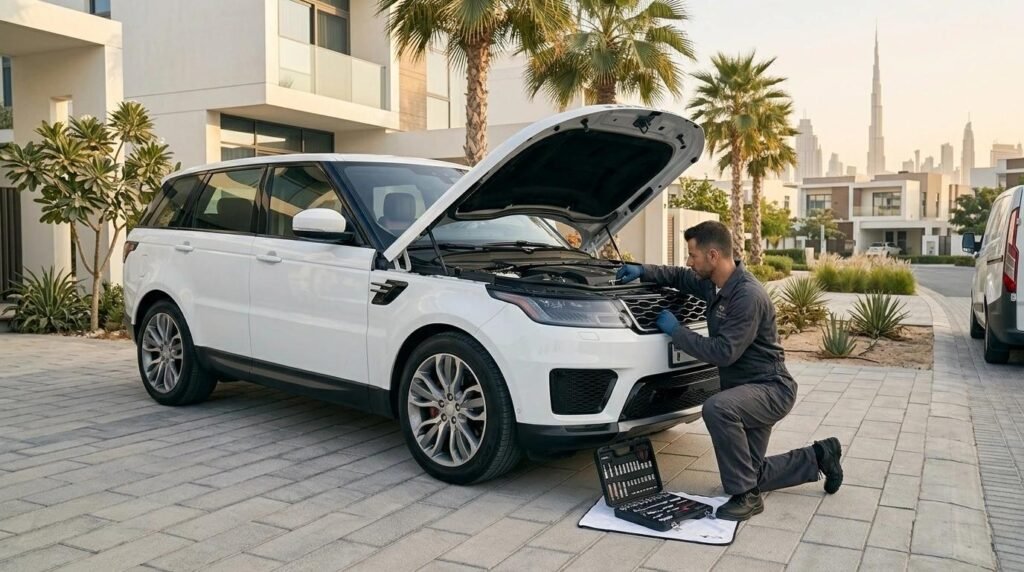
If your car won’t start, a mobile service can test and replace the battery at your home or office, which saves a tow. See our mobile car repair in Dubai service.
3. Tyres: Where Heat Meets the Road
Hot asphalt raises tyre temperature and pressure. Under-inflated, worn, or old tyres are a common cause of blowouts on fast roads like E311 or E11. Dubai Police regularly run summer awareness campaigns about tyre safety for this reason.
Monthly tyre check:
Pressure: Check with tyres cold, in the morning or before driving, using the figure on the door-jamb sticker. Don’t deflate a hot tyre
Tread depth: Replace tyres before they get close to the legal minimum
Age: Look for the four-digit date code on the sidewall (for example, “2423” means week 24 of 2023). Rubber hardens and cracks with age even if the tread looks fine
Damage: Look for cracks, bulges, or nails
Also rotate tyres and check wheel alignment regularly. Kerbs and potholes after rain can throw alignment out.
4. Brakes: Stop-and-Go Takes Its Toll
Heavy traffic means frequent braking, and heat reduces how well brake fluid and pads cope.
What to check:
Brake pad thickness every service, or about every 10,000 km
Brake fluid, which absorbs moisture over time. Many manufacturers recommend replacing it every two years
Discs for scoring, warping, or a vibrating pedal
Warning signs: squealing or grinding, a soft pedal, the car pulling to one side, or a longer stopping distance. Don’t delay brake work. It is a safety item.
5. Coolant and Cooling System: Preventing Overheating
The cooling system keeps your engine from overheating. In a UAE summer, it works at its limit, especially in traffic.
Checklist:
Check coolant level monthly when the engine is cold. Never open the radiator cap on a hot engine
Use the coolant type specified for your car, mixed with distilled water in the correct ratio
Inspect hoses for cracks and the radiator for leaks or blockage from dust
Have the thermostat and water pump checked if the temperature gauge rises in traffic
If your car overheats: Pull over safely, switch off the engine, turn on the hazards, and wait for it to cool before checking anything. Call roadside assistance if needed.
6. Air Conditioning: Not Optional Here
In the UAE, AC is a safety system. A failing AC causes fatigue and discomfort, and it can affect concentration on long drives.
Keep it healthy:
Service the AC system before summer (April or May is ideal)
Replace the cabin air filter every 10,000–15,000 km, or sooner on dusty routes
Clean the condenser at the front of the car, which gets clogged by dust and insects
Get the refrigerant level and compressor checked if cooling weakens
Warning signs: warm air at idle, weak airflow, a musty smell, or strange noises when the AC starts.
7. Air Filter, Wipers, Lights and Fluids
Small items matter too:
Engine air filter: Dust-clogged filters reduce performance and fuel economy. Check it more often than the manual suggests
Wipers: Heat cracks rubber. Replace them yearly, because you’ll want them for sudden winter downpours
Windscreen washer fluid: Top it up regularly to clear dust
Lights: Test headlights, brake lights, and indicators monthly
Windscreen: Fix chips quickly. Heat can spread small cracks
8. Suggested UAE Maintenance Schedule
Item How often (UAE conditions)
Engine oil and filter Every 5,000–7,500 km
Battery test Every 6 months
Tyre pressure Monthly
Brake inspection Every 10,000 km
Coolant level Monthly in summer
AC service Once a year, before summer
Cabin filter Every 10,000–15,000 km
Brake fluid Every 1–2 years
Wiper blades Yearly
Always follow your manufacturer’s manual as the baseline, and ask your mechanic to adjust for your driving habits.
9. Hot-Weather Habits That Protect Your Car
Good habits cost nothing:
Park in shade or covered parking when you can, and use a windscreen sun shade
Don’t leave pressurised items like spray cans, lighters, or power banks in the cabin
Keep a spare water bottle and basic emergency kit in the boot
Let the AC run with windows open for a minute to push out trapped hot air
Keep your fuel tank above a quarter, since driving on a near-empty tank can strain the fuel pump
Wash the car regularly, since dust and salt can damage paint over time
10. Planning Around the Annual Vehicle Test
Vehicles in Dubai generally need to pass a technical inspection at an RTA-approved centre for registration renewal once they pass the initial exemption period. Common reasons for failure include worn tyres, weak brakes, faulty lights, and emissions problems. A pre-test service lets you fix these first. Check the RTA website for current requirements. For federal information on vehicles and registration, see the UAE government portal.
11. DIY vs Professional Service
You can check tyre pressure, fluid levels, lights, and wipers yourself. Leave these to professionals:
Computer diagnostics and fault codes
Brake repairs and fluid changes
AC regas and compressor work
Cooling system flushes
Battery testing and charging system checks
A good workshop explains each finding in plain language, shows you worn parts, and gives you a written estimate. Our guide on how to choose a car repair service in Dubai explains what to look for.
Frequently Asked Questions
How often should I service my car in the UAE?
Most cars need servicing every 5,000 to 10,000 km or every six to twelve months, depending on the manufacturer. In UAE heat and traffic, the shorter interval is safer, especially for engine oil, filters, and brake checks.
How long does a car battery last in Dubai?
Car batteries in Dubai often last around two to three years because heat accelerates wear. Get it tested every six months, and replace it early if cranking slows or lights dim, before it leaves you stranded.
What is the best engine oil for UAE heat?
Use the grade in your owner’s manual. Fully synthetic oil usually resists high temperatures and breakdown better than conventional oil, which makes it a popular choice in the UAE. Ask your mechanic to confirm the right viscosity for your engine.
How do I stop my car overheating in summer?
Check coolant monthly when the engine is cold, keep the radiator and hoses in good condition, and service the cooling system before summer. If the temperature gauge rises, pull over safely, switch off the engine, and let it cool.
When should I service my car’s AC in the UAE?
Service your AC once a year, ideally before summer starts in April or May. Replace the cabin filter every 10,000 to 15,000 km, and get it checked sooner if cooling weakens or you notice odd smells.
Is mobile car maintenance available in Dubai?
Yes. Mobile services can handle oil changes, battery replacement, brake pads, and basic diagnostics at your home or office. It’s handy in busy areas like Business Bay, JLT, and Dubai Marina. Major repairs still need a full workshop.
Conclusion
Good car maintenance in the UAE is mostly consistency. Check your oil, battery, tyres, brakes, coolant, and AC on a regular schedule, adjust for heat, dust, and traffic, and don’t ignore small warning signs. A few minutes each month can save you from a roadside breakdown in 45°C weather.
Ready for a worry-free summer? Book your car maintenance service with AutoFix Dubai. Call [phone number], message us on WhatsApp, or book online at autofixdxb.com. We offer workshop service and mobile car repair across Dubai.